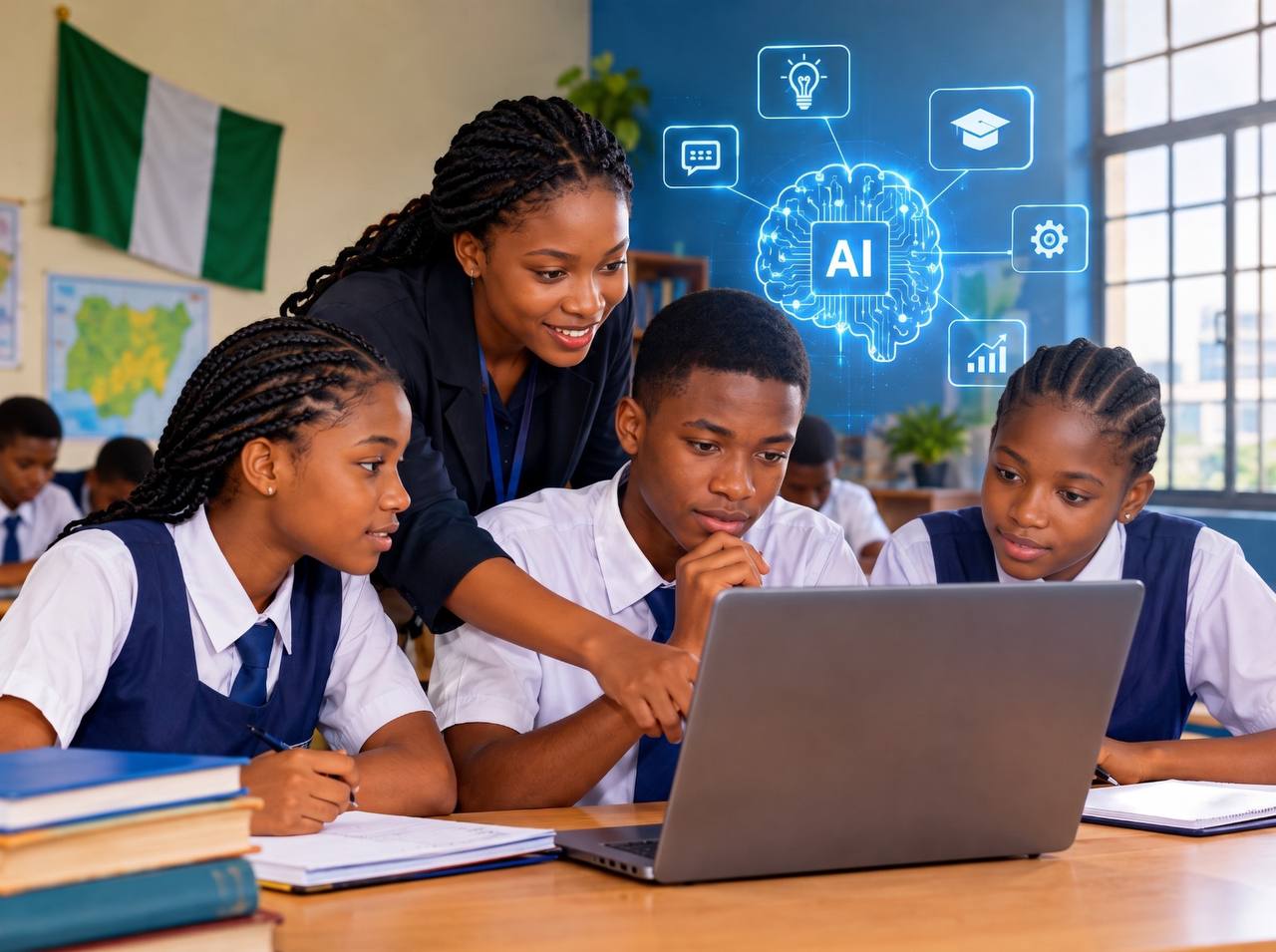
A student receives an assignment, opens an AI tool and types a simple prompt:
“Write an essay on climate change.â€
Seconds later, the essay appears. The grammar is polished. The structure is impressive. The arguments sound intelligent, but one important question remains: Did the student actually learn anything?
This question is becoming increasingly important in Nigerian schools. Artificial intelligence is changing how students access information, complete assignments and approach learning. Recent discussions around AI adoption in Nigeria have highlighted both its potential to support personalised learning and concerns about overdependence, academic integrity and the possible erosion of critical thinking.
The issue, therefore, is not whether Nigerian students will use AI. The issue, therefore, is not whether Nigerian students will use AI , many already are. The real challenge is ensuring that, as AI gets better at generating answers, students get better at asking questions. The scale of this shift is already visible beyond Nigeria's borders.
A 2025 survey of UK university students found that 92% now use AI tools in their studies, up from 66% the year before, with 88% using generative AI specifically for assessments, compared to just over half the year prior. Nigeria's classrooms are moving in the same direction, and schools that wait for clearer data before responding risk falling behind the shift already underway among their own students. (Source: HEPI/Kortext Student Generative AI Survey 2025.)
When Getting the Answer Becomes Too Easy
For years, students have been rewarded for finding the correct answer. Memorise the formula, recall the definition. Reproduce what was taught in class, but AI has changed the relationship between students and information.
Today, an answer can arrive before a student has had the opportunity to wrestle with the question.
That matters because struggle is often part of learning.
Students develop intellectual independence when they compare ideas, make mistakes, defend opinions, and revise their thinking. If AI completes every difficult task on their behalf, students may submit excellent work without developing the reasoning required to produce excellent thinking.
As education philosopher John Dewey famously said, “We do not learn from experience... we learn from reflecting on experience.â€
AI can provide information. Reflection is still the student's responsibility. This is particularly significant for Nigeria, where conversations about preparing young people for an increasingly digital economy are growing.
AI literacy initiatives are already emerging, while educators and researchers continue to call for stronger critical thinking, digital skills, and responsible technology use.
The New Skill Students Need: Questioning AI
AI is not always correct. It can generate inaccurate information, reproduce bias, and present false claims with remarkable confidence. This means simply receiving information is no longer enough. Students must learn to interrogate it.
A future-ready learner should be able to ask:
- Where did this answer come from?
- What evidence supports it?
- What information might be missing?
- Does another credible source agree?
- What is my own interpretation?
This is where education must shift from answer-centred learning to thinking-centred learning.
Instead of asking students to use AI merely to complete an assignment, teachers can challenge them to evaluate an AI-generated response, identify its weaknesses, and improve it using their own research and reasoning.
In that moment, AI becomes a tool for learning rather than a shortcut around it.
Teachers Are More Important in the AI Era
There is a misconception that AI will reduce the need for teachers. In reality, teachers may become even more important.
When information is everywhere, students need help distinguishing useful information from misleading information. When AI produces instant answers, students need teachers who can challenge them to explain their reasoning.
The teacher's role is evolving from simply delivering information to designing meaningful learning experiences that require support.
Teachers need tools that reduce repetitive administrative tasks and create more time for what technology cannot easily replace: human judgement, mentorship, and meaningful interaction.
Building an AI-Ready School with Edves
This is where Edves comes in.
Edves believes that introducing AI into education should not mean removing teachers from the learning process. Instead, AI should strengthen the work teachers already do.
Through Pedagogy with AI, Edves gives teachers practical ways to bring AI into the classroom without losing control of it. Teachers can use AI-assisted tools to draft lesson plans and generate differentiated materials faster while designing assessments that ask students to evaluate, critique, or build on an AI-generated response, rather than simply submit one. Professional judgement stays exactly where it belongs with the teacher.
Imagine a teacher who spends less time drafting lesson plans from scratch and more time helping students explore ideas, because the groundwork is already done.
Imagine a school where assessments are designed to catch shallow, AI-generated answers and reward students who can defend their thinking instead.
Imagine students who do not just know how to use AI but understand when to question it.
That is the kind of future Edves is helping schools build.
AI should not become a replacement for thinking. It should become a tool that challenges students to think more deeply.
The Future Will Belong to Independent Thinkers
Nigeria's students are entering a world where AI will influence education, work and everyday decision-making.
The most valuable skill may not be knowing how to get an answer from a machine, It may be knowing whether that answer deserves to be trusted.
As AI becomes more powerful, schools must become more intentional about developing critical thinking, creativity, and sound judgement.
The question is no longer, “How do we stop students from using AI?â€
The better question is
“How do we teach students to remain thinkers while using AI?â€
Prepare Your School for the AI-Powered Future
The future of learning is already here. Give your teachers the tools to teach more effectively and your students the skills to think beyond the answers.
Book a demo with Edves today and discover how pedagogy with AI can help your school build smarter teaching, meaningful learning, and future-ready students.