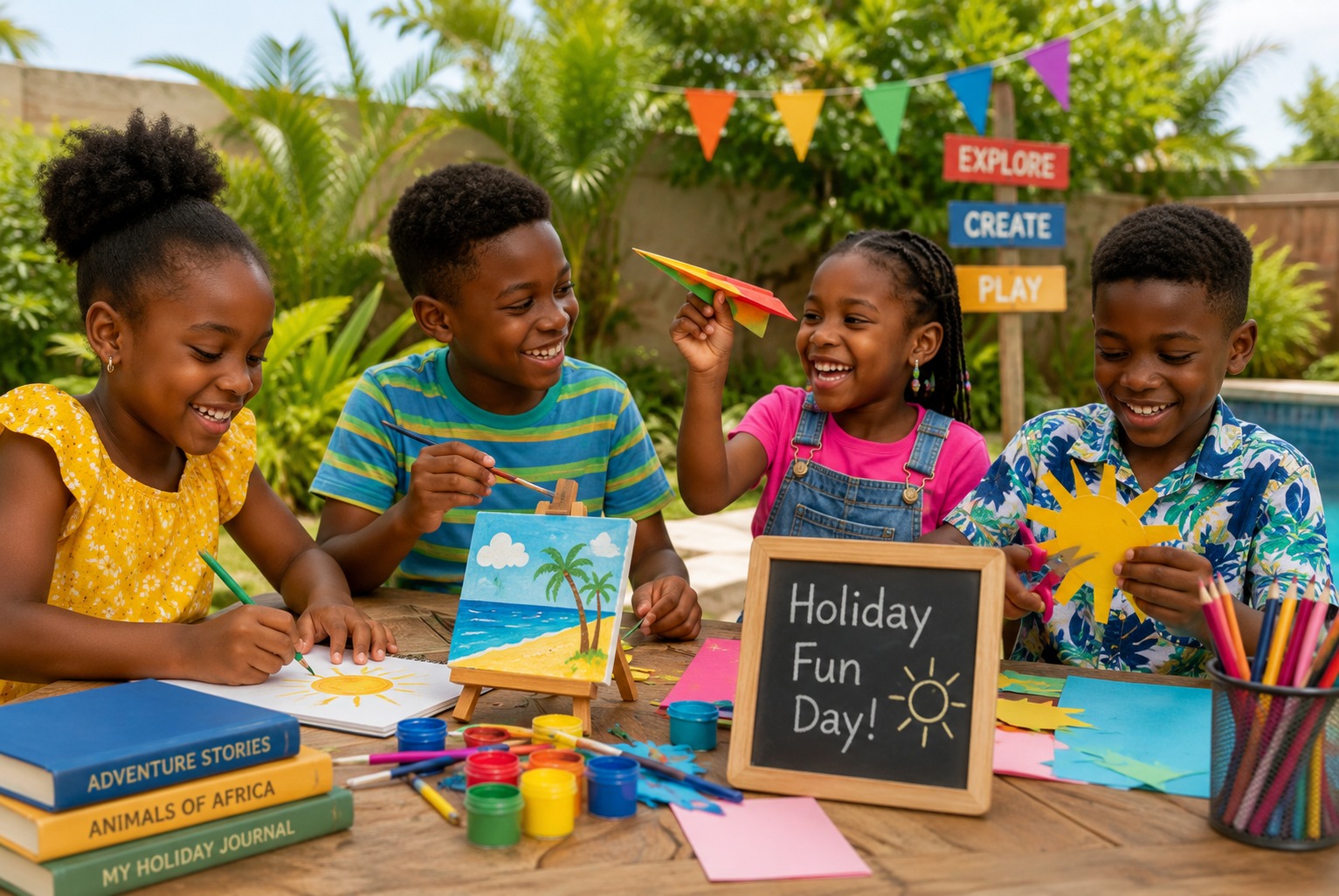
When schools close for a long holiday, students gain something increasingly rare in today's fast-moving world uninterrupted time.
How that time is spent can shape far more than the next school term.
Education research has consistently shown that students who stay mentally engaged during extended breaks are better positioned to retain knowledge, strengthen critical thinking, and return to school with greater confidence. By contrast, long periods without purposeful learning can contribute to what educators commonly describe as the "summer learning loss" or "holiday learning slide," where academic skills gradually weaken over time.
That doesn't mean students should spend their holidays recreating the classroom at home.
A productive holiday isn't about filling every hour with schoolwork. It's about creating a healthy balance between rest, exploration, creativity, and continuous learning. A few intentional habits, repeated consistently, can transform weeks of free time into an opportunity for personal growth, new skills, and renewed motivation.
Whether you're a student planning your break or a parent looking for meaningful holiday learning ideas, these 15 activities provide a practical framework for making every week count.
We will begin with 8 activities, in no specific order, in this part of our holiday series, and conclude in the next part.
1. Learn Coding with Codecraft
Among all the productive holiday activities available today, learning to code stands out for one simple reason: it teaches students how to think, not just what to know.
Coding develops logical reasoning, creativity, problem-solving, persistence, and digital confidence skills that extend well beyond computer science and into nearly every career students may pursue in the future.
That's where Codecraft, EDVES' interactive coding environment, comes in.
Designed specifically for beginners, Codecraft introduces students to programming through guided, project-based learning, rather than overwhelming theory or lengthy tutorials. Students build practical skills step by step, learning concepts such as logical sequencing, computer language, and computational thinking while creating projects they can proudly share.
The experience is intentionally accessible. Because Codecraft is integrated directly into the EDVES platform, students don't need additional software, complicated installations, or separate accounts. They simply log in and begin learning at their own pace.
Parents and teachers can also see tangible progress, not simply that a student spent time online, but that they completed lessons, solved challenges, and created something meaningful.
Among holiday learning activities, coding offers a rare combination of creativity, analytical thinking, and practical digital skills that continue to benefit students long after the holiday ends.
Just 20 to 30 minutes a day can be enough to finish the break with a portfolio project, stronger problem-solving abilities, and greater confidence in using technology to create rather than simply consume.
2. Read Widely, Not Just for School
Reading remains one of the strongest predictors of long-term academic success, but the school holiday offers something the classroom often cannot: complete freedom of choice.
Instead of reading only assigned texts, students can explore stories, biographies, science, history, technology, personal development, or any topic that genuinely sparks curiosity. Even graphic novels and age-appropriate magazines help build vocabulary, comprehension, and imagination while encouraging consistent reading.
The objective isn't to complete a long reading list.
It's to rediscover the enjoyment of reading without the pressure of examinations or deadlines.
One simple habit can make a remarkable difference: reading for 20 minutes before using social media or watching television.
Over several weeks, those small daily sessions can amount to hundreds of pages and a stronger foundation for the next school term.
3. Improve Handwriting and Note-Taking
Although there is massive digital advancement in education, handwriting remains an important academic skill.
Students still complete written examinations, take classroom notes, and communicate ideas on paper. Clear handwriting not only improves presentation but also helps students organize their thinking while writing.
Improvement doesn't require hours of practice.
Spending just 10 to 15 minutes each day copying a well-written paragraph, practicing letter formation, or slowing down to focus on neatness can produce noticeable progress over the course of a holiday.
Pairing handwriting practice with better note-taking techniques, such as summarizing ideas instead of copying them word for word, also strengthens comprehension and memory. Sometimes the smallest habits create the biggest improvements.
4. Strengthen Communication Skills
Strong communication is one of the most valuable life skills a student can develop.
Whether answering questions in class, delivering presentations, applying for scholarships, or preparing for future careers, the ability to express ideas clearly often matters as much as academic knowledge itself.
The holiday provides a low-pressure environment to practice.
Students can record a one-minute video explaining a favorite topic, write a short article, interview a family member, participate in community discussions, or simply commit to device-free conversations during meals.
Each conversation builds confidence.
Each written paragraph improves clarity.
Each presentation develops skills that will continue opening doors long after school.
5. Practice Mathematics in Small, Consistent Sessions
Mathematics is cumulative. New concepts build on previous ones, making long breaks particularly challenging if students stop practising altogether.
Practising and maintaining mathematical confidence doesn't require hours of worksheets.
Educational research consistently suggests that frequent, short practice sessions help students retain concepts more effectively than occasional marathon study periods.
15 to 20 minutes each day is often enough.
Students can revisit topics they previously found difficult, solve logic puzzles, practice mental arithmetic, or complete a few carefully selected exercises that reinforce key concepts.
Consistency, not intensity, is what keeps mathematical thinking sharp throughout the holiday.
6. Make Time for Creativity
Creativity is often treated as an extra rather than an essential part of learning.
In reality, creative thinking strengthens problem-solving, resilience, adaptability, and innovation qualities that are becoming increasingly valuable across every profession.
The school holiday offers students something the academic calendar rarely provides: uninterrupted time to create. Drawing, painting, photography, music, storytelling, filmmaking, crafting, designing games, building with construction sets, or experimenting with digital art all encourage students to think differently while developing patience and perseverance.
Not every creative project needs a purpose beyond enjoyment.
Sometimes the freedom to explore is itself one of the most valuable educational experiences.
7. Volunteer and Give Back to the Community
Some of the most meaningful lessons are learned outside the classroom.
Volunteering introduces students to responsibility, empathy, teamwork, and leadership while helping them understand the needs of people beyond their immediate circle.
Community service doesn't have to be formal. Students might support a local charity, assist at a place of worship, participate in neighbourhood clean-up initiatives, mentor younger children, visit older relatives, or simply help neighbours who need assistance.
These experiences develop emotional intelligence alongside practical life skills. They also help students discover that making a positive contribution to others can be just as rewarding as achieving personal success.
8. Learn to Type Faster and More Accurately
Typing has become one of the most overlooked academic skills. As classrooms increasingly adopt digital learning, students spend more time completing assignments, writing essays, conducting research, taking online assessments, and preparing presentations using computers.
Typing slowly doesn't simply waste time; it interrupts thinking. When students can type confidently without searching for every key, they are better able to focus on organizing ideas, solving problems, and expressing themselves clearly.
Fortunately, this is one of the easiest skills to improve.
Just 15 minutes of daily practice throughout the holiday can significantly increase both typing speed and accuracy, creating benefits that extend into secondary school, university, and future careers. Like reading or mathematics, the greatest improvements come through consistent, manageable practice rather than occasional intensive sessions.
A productive holiday isn't measured by how busy students become. It's measured by the habits they develop, the confidence they gain, and the skills they carry into the next school term/year.
Each small achievement becomes another building block for lifelong learning.