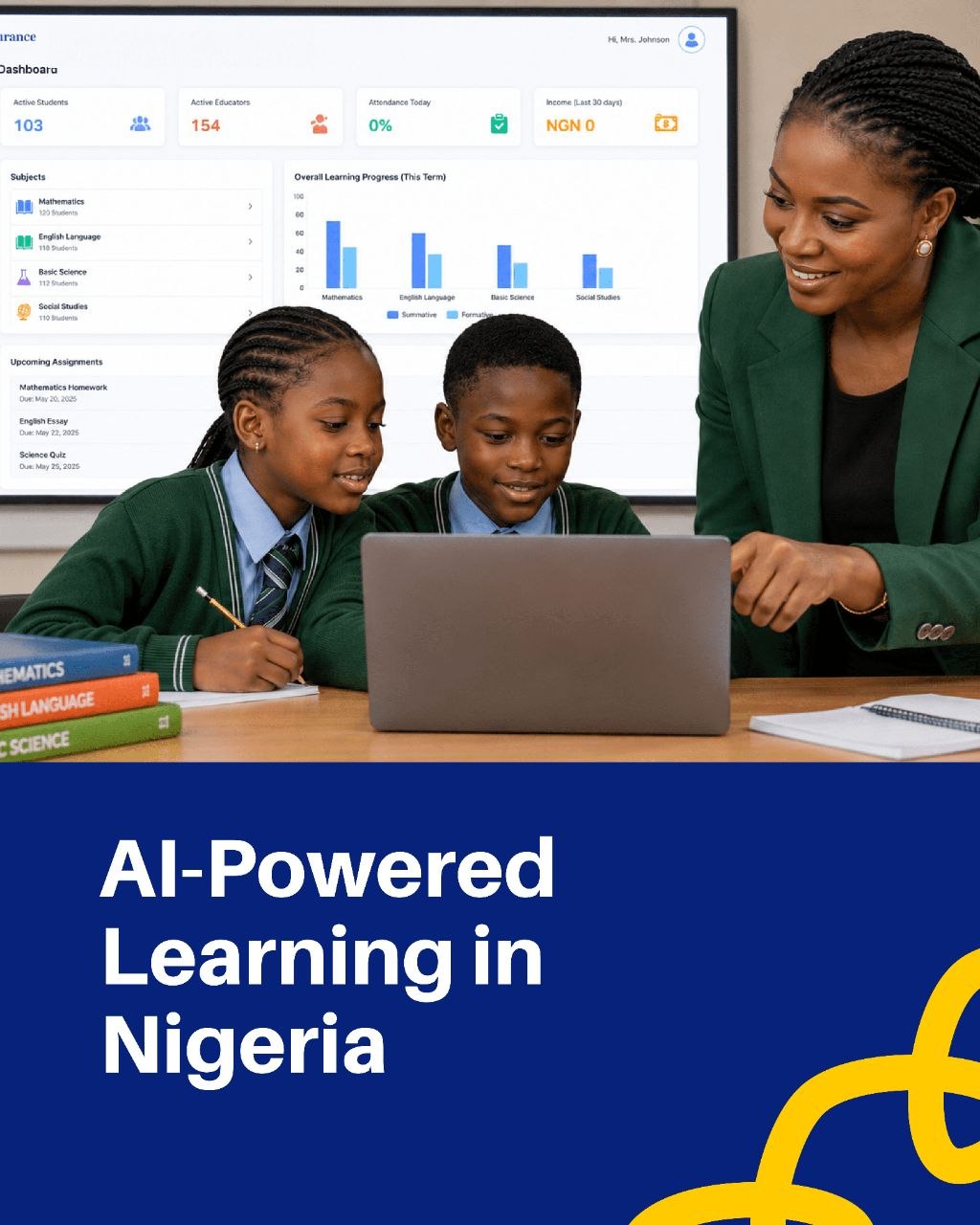
Walk into a growing number of Nigerian schools today, and you'll notice something different. It's not just the presence of computers or projectors. It's the way lessons respond to students, the way test results get analyzed in minutes instead of weeks, and the way school administrators spend less time on paperwork and more time on actual teaching decisions.
This is what AI-powered learning looks like in practice. Not a distant, futuristic concept, but a set of tools already reshaping how Nigerian students learn and how schools run.
Why Nigeria Is Ready for This Shift
Nigeria's education system carries real pressure. Classrooms are often large, resources are stretched, and teachers are expected to give every child individual attention with very little time to do it. At the same time, Nigeria has one of the youngest, most digitally curious populations in the world, and smartphone penetration keeps rising even in secondary cities and towns.
That combination, a strained system and a tech-ready population, is exactly where AI tools find their footing. They don't replace teachers. They give teachers back time and give students a more personalized path through material they might otherwise struggle with silently.
What AI-Powered Learning Looks Like Day to Day
It's easy to talk about AI in the abstract. Here's what it actually does inside a school:
- Adaptive learning platforms adjust the difficulty of exercises based on how a student performs, so a child who's struggling with fractions gets more practice there instead of moving on unprepared.
- Automated grading and feedback free teachers from spending evenings marking objective tests, giving them more time for lesson planning and one-on-one support.
- AI-assisted school management systems handle attendance, timetabling, fee tracking, and performance reporting, cutting down the administrative load that pulls school leaders away from actual education work.
- Early intervention flags help teachers spot which students are falling behind before it shows up as a failed term, using patterns in assignment scores and engagement rather than waiting for exam results.
- Language and literacy support tools help students who are more comfortable in a local language build stronger English proficiency, which matters enormously in Nigeria's multilingual classrooms.
None of this is science fiction. Schools using platforms like Edves are already seeing these features built into daily operations, not as an add-on but as part of how the school functions.
The Real Barrier Isn't the Technology
The honest conversation to have here is about access, not capability. AI tools work. The bigger question is whether schools have stable internet, devices, and the training to use these systems well. In many parts of Nigeria, especially outside major cities, this is still the actual constraint.
This is why the schools seeing the most benefit from AI-powered learning aren't necessarily the most expensive ones. They're the ones that picked tools built with Nigerian realities in mind, systems that work on lower bandwidth, that support offline functionality, and that don't assume every student has a personal laptop at home.
What This Means for School Leaders Right Now
If you're running a school or making decisions about edtech adoption, the practical starting point isn't "should we use AI." It's narrower and more useful than that:
Where is your school currently losing the most teacher time to manual work?
Where are students falling behind in ways your current system doesn't catch early enough?
What tools already exist that solve those two problems without requiring infrastructure you don't have?
Answering those questions tends to point toward the same conclusion many Nigerian schools have already reached: AI-powered tools aren't a luxury upgrade. They're becoming the baseline for running a school efficiently in 2026.
Looking Ahead
AI-powered learning in Nigeria is still early, but it's no longer experimental. It's showing up in report cards, in how quickly parents get updates on their child's progress, and in how much less time teachers spend on tasks that don't require a human being to do them.
The schools that adapt now aren't just keeping up with a trend. They're positioning themselves to give every student the kind of individual attention that used to be possible