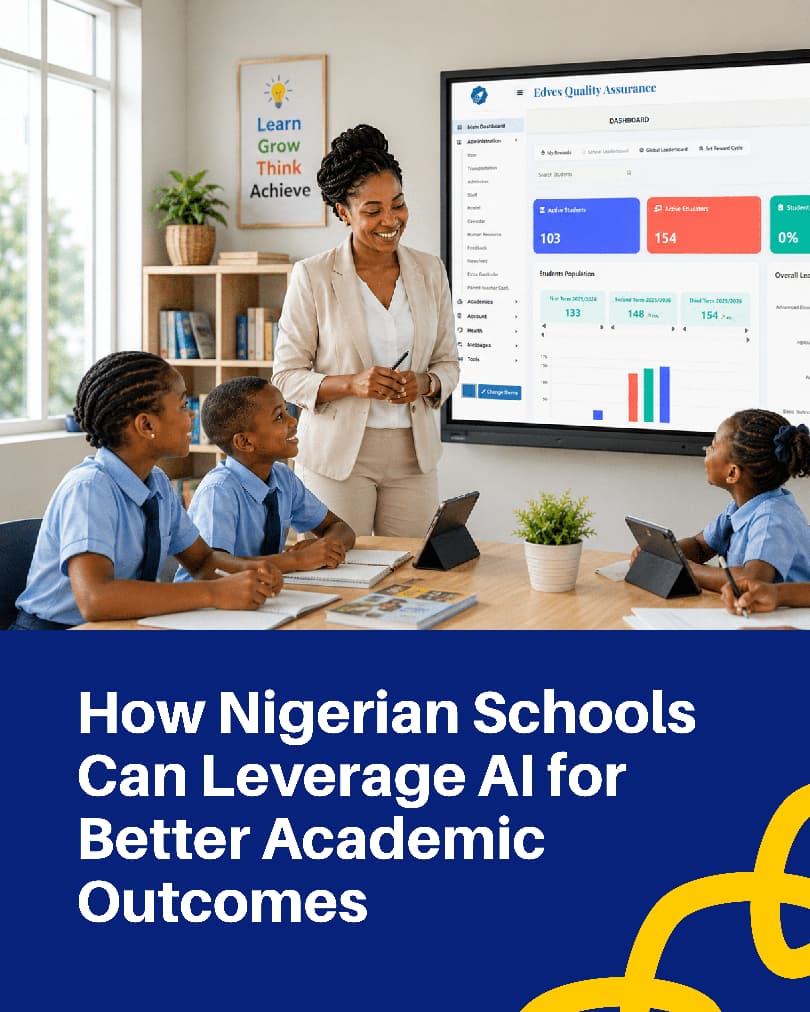
Every school leader in Nigeria has heard some version of the same complaint. Class sizes are large, resources are limited, and it's nearly impossible to give every student the individual attention they need, actually, to improve. AI doesn't remove that pressure. But it does give schools a way to work with it more intelligently instead of against it.
The schools already seeing measurable gains in academic performance aren't necessarily spending more money. They're using AI to close specific, identifiable gaps that used to go unnoticed until report cards came out.
Start With What's Actually Slowing Students Down
Academic outcomes suffer for very specific, traceable reasons: a student missed a foundational concept months ago and has been struggling silently ever since, a teacher has forty students and can't catch every learning gap in real time, or feedback on assignments comes back too late to change how a student studies for the next test.
AI tools are effective precisely because they attack these exact problems, not because they're a general upgrade to "modern" education.
Practical Ways AI Improves Academic Outcomes
Personalized learning paths. Instead of every student working through the same pace and sequence, adaptive platforms adjust material based on how a student is actually performing. A student who's ahead moves faster. A student who's behind gets more support in that specific area before moving on, rather than being pushed forward with a gap that compounds later.
Early warning systems. One of the most underrated uses of AI in schools is catching decline before it shows up on an exam. Patterns in assignment completion, quiz scores, and engagement can flag a student who's starting to fall behind weeks before a teacher would notice through observation alone.
Faster, more consistent feedback. Automated grading for objective assessments means students get results and corrections almost immediately, while the material is still fresh, instead of a week or two later when the moment to actually learn from a mistake has passed.
Data-backed teaching decisions. School leaders and teachers make better calls when they can see real performance data across a term, not just anecdotal impressions. AI-powered dashboards turn raw scores and attendance into patterns that are actually useful for deciding where to focus.
Reduced administrative load on teachers. Every hour a teacher spends manually compiling scores or tracking attendance is an hour not spent preparing better lessons or giving extra support to a struggling student. Automating the administrative side directly frees up time for the parts of teaching that actually move academic outcomes.
What This Looks Like With the Right System in Place
Schools using platforms like Edves see this play out in a fairly consistent way. Teachers spend less time on repetitive administrative tasks. School leaders get clearer visibility into which classes or subjects need attention. Parents get more timely, accurate updates on their child's progress. And students get support that's shaped around how they're actually performing, not a one-size-fits-all pace set for the whole class.
None of this requires abandoning how Nigerian schools already operate. It requires a system that fits into the existing structure and makes the parts that were always time-consuming or hard to track significantly easier.
Getting Started Without Overhauling Everything
Schools don't need to adopt every AI feature at once to see results. The most effective starting point is usually the narrowest one:
- Identify the single biggest source of lost teacher time, whether that's grading, attendance, or report compilation.
- Identify the point in the term where students typically start falling behind without anyone noticing early enough.
- Choose a system that addresses those two things first, then expand from there.
Academic outcomes improve when problems get caught early and addressed consistently, not when schools chase every new tool on the market. AI makes that consistency possible at a scale that manual effort alone can't match.
The Bigger Picture
Nigerian schools don't need to choose between tradition and technology. The schools improving academic outcomes right now are the ones using AI to support what good teachers were already trying to do, just without the time and visibility to do it for every single student. That's the actual value AI brings to Nigerian classrooms in 2026, not replacing teaching, but finally giving it the support it always needed.
Where Edves Fits In
This is exactly the gap Edves was built to close. Edves brings AI-powered tools into a single school management system, handling attendance, grading, performance tracking, and reporting so teachers spend less time on paperwork and more time on students who need them. School leaders get a clear, real-time view of where students are excelling and where they're falling behind early enough to actually do something about it.
If your school is ready to move from guesswork to data-backed decisions, Edves makes that shift simple, without requiring a full technology overhaul or a steep learning curve for your staff.
Book a free demo to see how it works for schools like yours.